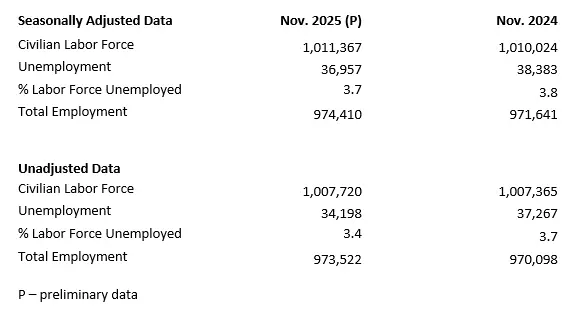


Idaho’s seasonally adjusted unemployment rate in November was 3.7%. This rate matches the 3.7% unemployment rate published in September. October labor force data was not available due to the federal government shutdown.
November’s labor force was 1,011,367 while the labor force participation rate – the percentage of people 16 years or older who are either employed or looking for work – was at 62.9%. Total employment was 974,410 and unemployment was 36,957.
Current Employment Statistics (CES) — which was available for both October and November — showed Idaho’s nonfarm jobs increased by 2,900 (0.3%) jobs for a total of 884,600 in November. Industry sectors with the greatest over-the-month gains included construction (2.3%); accommodation and food services (1.2%); private educational services (1.2%); administration, support and waste management services (0.6%); finance and insurance (0.6%) and durable goods manufacturing (0.5%).
Industries that experienced job losses in November included natural resources (-2.2%); arts, entertainment and recreation (-1.2%); wholesale trade (-0.9%); real estate and rental and leasing (-0.8%); federal government (-0.7%); state government (-0.6%); transportation, warehousing and utilities (-0.6%) and professional, scientific and technical services (-0.5%).
Three of Idaho’s six Metropolitan Statistical Areas (MSAs) had over-the-month nonfarm job increases in November. Twin Falls saw the largest increase at 0.6%, followed by Coeur d’Alene (0.3%) and Boise (0.2%). Lewiston experienced the largest decrease (-0.7%), followed by Idaho Falls and Pocatello (-0.2%).
Year over Year
Idaho’s 3.7% unemployment rate for November 2025 was down from 3.8% in 2024. The labor force grew 0.1% (1,343), as the number of employed Idahoans increased by 2,769 (0.3%). The number of unemployed Idahoans decreased by 1,426 (-3.7%).
Total nonfarm jobs increased by 1.3% (11,700). Most major industry sectors gained jobs except federal government (-8.2%); wholesale trade (-7.2%); state government (-3.8%); administration, support and waste management services (-0.9%); nondurable goods manufacturing (-0.9%); retail trade (-0.3%) and transportation, warehousing and utilities (-0.3%).
All but one of Idaho’s MSAs had year-over-year nonfarm job gains in November. Coeur d’Alene had the greatest increase at 2.1%, followed by Boise (1.6%), Twin Falls (1.4%), Pocatello (1.0%) and Idaho Falls (0.7%). Lewiston experienced a decrease (-0.3%).
National Comparisons
Nationally, the unemployment rate was 4.6% in November with 7.8 million unemployed. Total nonfarm jobs rose by 64,000 to 159.6 million.