

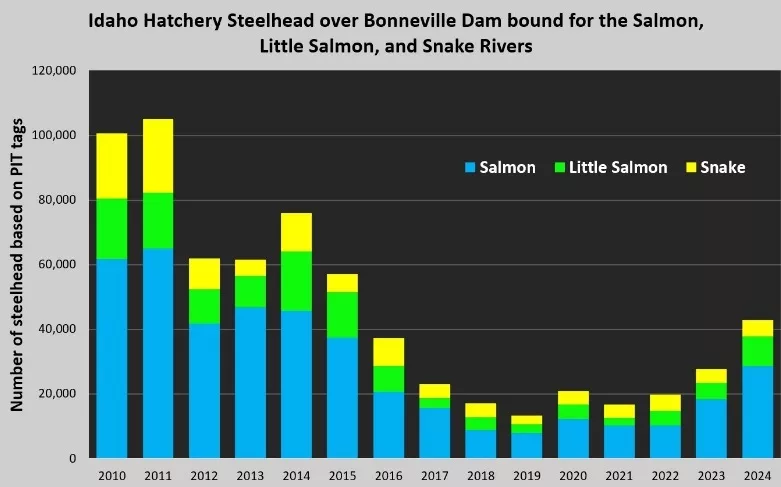
LEWISTON, ID – The return of steelhead to the combined area of the Snake, Upper Salmon, and Little Salmon rivers is the best since 2015, according to an Idaho Department of Fish and Game fisheries manager. Joe DuPont with the Clearwater Region says 42,799 Idaho hatchery steelhead have passed over Bonneville Dam this year (based on PIT tags) and are headed to the three rivers.
“About 29,000 of these fish will be returning to the upper Salmon River basin, 9,200 to the Little Salmon River, and about 4,900 to the Snake River,” DuPont says. “Returns to the upper Salmon River and Little Salmon River are big improvements over the previous 8 years, but the return to the Snake River (Hells Canyon Dam) is similar to the previous two years.”
DuPont adds that another exciting thing about this return is that over 80% of the fish returning to these areas are fish that spent two or three years in the Pacific Ocean.
“Typically, about 40% of the return to these areas are 2 or 3-ocean fish and 60% spend just one year in the ocean. That means, not only will we be seeing the biggest return in nine years to these areas, but these fish will also be larger,” he says.
In an average year, about 80% of the fish destined for the Snake, Upper Salmon, and Little Salmon rivers that pass over Bonneville Dam will eventually make it to Idaho. DuPont expects similar survival rates this year based on passage data at Lower Granite Dam.
“So far, about 33,000 (76%) of these fish have passed over Lower Granite Dam. Right now, these steelhead are spread out in the Snake River from the Idaho/Washington border upstream to Hells Canyon Dam and in the Salmon River from its mouth upstream past the Pahsimeroi River. Catch rates in the Snake River downstream of the Salmon River have been averaging 12-13 hrs/fish which I would classify as “decent” fishing,” DuPont says. “If you like to fish the Snake River upstream of the Salmon River, fishing has been slow until just last week when we saw catch rates of around 13 hrs/fish. Since the first week of October, catch rates have been good in the lower Salmon River with catch rates averaging around 7-12 hrs/fish. Catch rates in the upper Salmon River have been improving weekly and last week averaged about 17 hrs/fish.
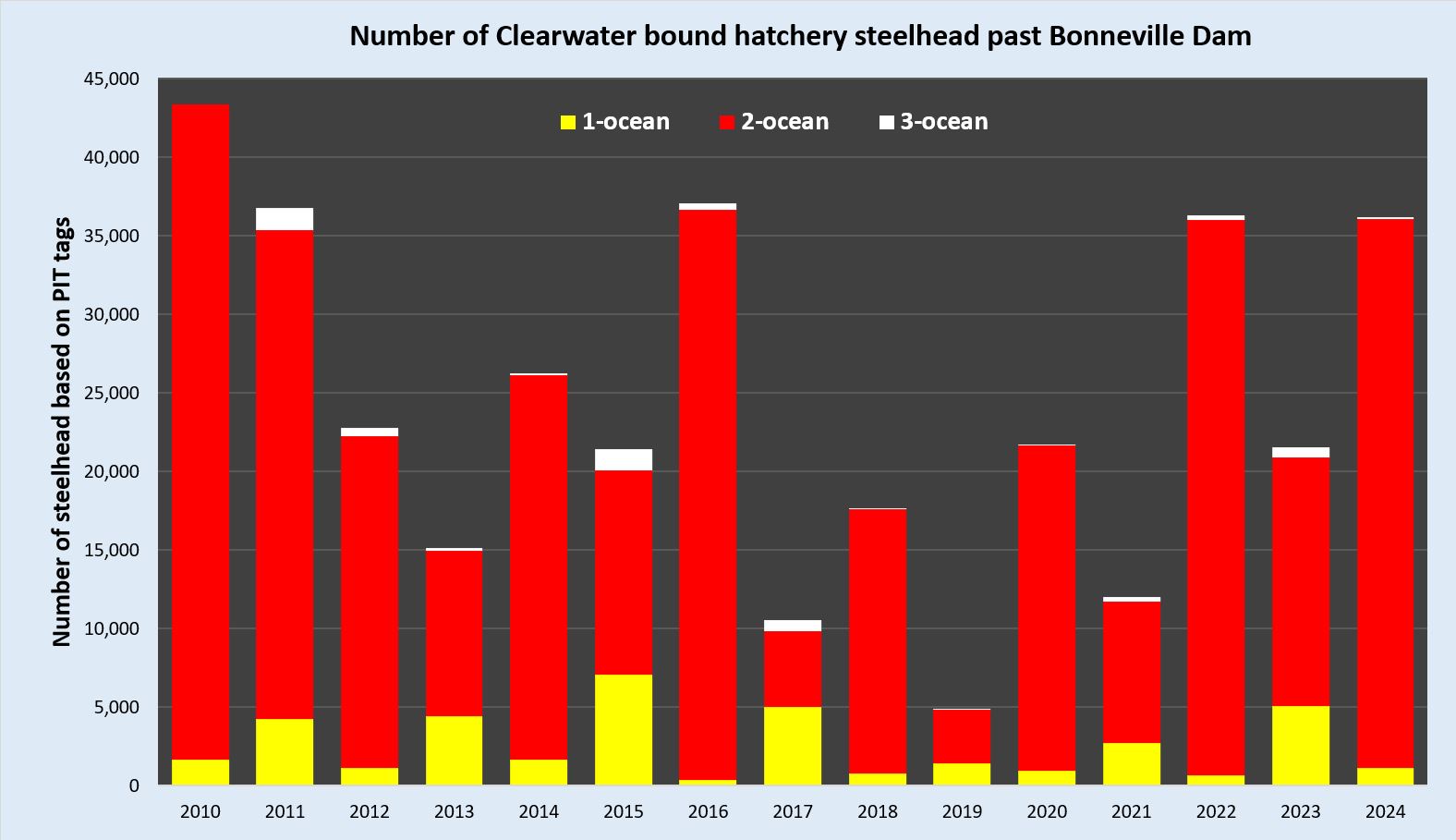
As for steelhead destined for the Clearwater River Basin, DuPont says over 36,000 hatchery steelhead have passed over Bonneville Dam this year.
“This return is similar to other great [years] like 2011, 2016, and 2022. Typically, 76% of these fish survive to make it past Lower Granite Dam,” he says, adding that over 23,000 Clearwater hatchery steelhead have passed over Lower Granite Dam. That is 65% of the Bonneville estimate.
“Based on the run timing in recent years, we will likely see over 25,000 steelhead (69-70% survival) pass over Lower Granite Dam when the run is over this spring. The lower-than-average survival is not too surprising as the larger the steelhead return is, the more impacts downstream fisheries can have on these fish,” DuPont says. “Regardless, this return will end up in the top five that we have seen since 2010 and should provide good fishing opportunities throughout the 2024-2025 fall and spring steelhead fisheries.”
DuPont says Clearwater River catch rates for steelhead have been steadily improving since the beginning of October when the Clearwater Basin hatchery fish started moving in.
“Last week, catch rates in the main Clearwater River [averaged] about 10 hrs/fish which I would classify as good fishing. I suspect catch rates will continue to improve until the catch-and-release fishery ends on November 10. The better catch rates have been observed closer to Lewiston and Dworshak Hatchery,” he says.
DuPont adds that more of the fish destined for the South Fork Clearwater River are starting to move into this fishery, and these fish tend to spread out more than the fish destined for Dworshak Hatchery. Hopefully, he says, this will result in more consistent fishing throughout the Clearwater River.
Meanwhile, DuPont says some people have been asking how Tribal and sport fishing harvest in the Snake River Basin could have influenced steelhead returns and catch rates in the Clearwater River Basin.
“Based on numbers reported to me, Tribal fishing efforts this fall have likely resulted in a harvest of 1,000 to 1,500 Clearwater bound steelhead and sport fisheries have harvested another 1,500 fish. If you subtract the harvest of these two fisheries (~3,000 fish) from the number of these steelhead that have passed over Lower Granite Dam, that leaves over 20,000 steelhead for the fall and spring fisheries. This is an ample number of fish to provide good fishing through the fall and spring fishing seasons,” he says.


